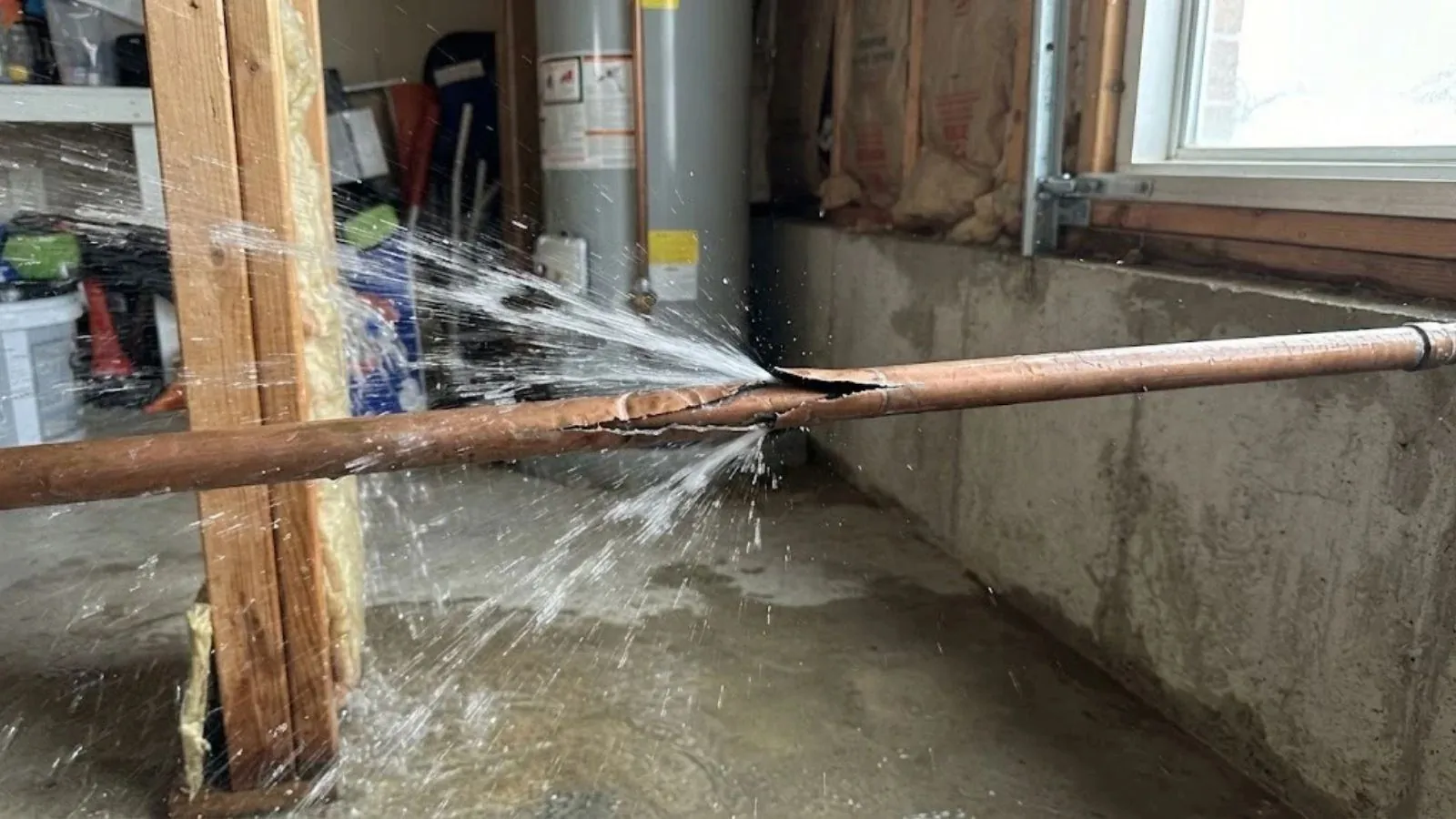
What to do in the first ten minutes
Do these in order. They limit damage faster than any repair can.
- STEP 01
Find and close the main
The main shutoff is usually where the line enters the house, at a meter box, in a garage or in a basement. Turn it clockwise until it stops.
- STEP 02
Cut power near water
If water is near outlets, appliances or the panel, turn off those circuits at the breaker only if you can reach it without standing in water.
- STEP 03
Drain the system
Open the lowest faucet and flush toilets once to relieve pressure and drain the lines.
- STEP 04
Turn off the water heater
Switch off the breaker or gas control so the heater does not run dry.
- STEP 05
Call and document
Call the emergency line, then photograph the break and the damage for your insurer.
Why pipes burst in a mild climate
Huntersville does not get long deep freezes, which lulls many homeowners into skipping winter prep. A single night below freezing can still burst an exposed outdoor spigot, an attic line or a crawlspace pipe that runs along an uninsulated wall.
Freezing is not the only cause. High water pressure, aging fittings, corrosion, a failed joint or a nail through a pipe can open a line in any season. A pressure gauge on a hose bib tells you whether the pressure is too high, and a plumber can fit a regulator if it is.
Burst, frozen, split or pinhole: what each looks like
The type of failure changes how the repair goes.
| Failure | What you see | Usual cause | Typical repair |
|---|---|---|---|
| Burst pipe | Spray or a gush, sudden loss of pressure | Frozen water or a failed fitting | Cut out and replace the section |
| Frozen but intact | Little or no flow from a tap | Cold exposure on an uninsulated run | Thaw slowly, then insulate |
| Split along the seam | Steady flow from a lengthwise crack | Ice expansion or fatigue | Replace the length of pipe |
| Pinhole leak | Fine spray or a green stain on copper | Corrosion from inside or outside | Spot repair, or repiping if widespread |
| Failed joint | Drip at a fitting that grows | Poor soldering, old crimp or loose compression | Re-make or replace the joint |
| Broken supply stop | Water at the base of a fixture | Aged or corroded valve | Replace the valve |
Never use a torch near wet wood, insulation or a crawlspace. Pipe repairs near combustibles need the right tools.
Pipe materials and how each one fails
The material determines the repair method and how long it will last.
| Material | Common failure | Repair method | Watch for |
|---|---|---|---|
| Copper | Pinholes, failed soldered joints | Cut out and sweat a new section | Several pinholes on one run suggest repiping |
| PEX | Leaks at fittings, UV damage outdoors | Replace the fitting or section | Mixed brands of fittings and tubing |
| CPVC | Brittle cracks near hot lines | Cut out and glue a new section | Old CPVC can crack when moved |
| Galvanized steel | Rust, low flow, leaks at threads | Replace the section with new pipe | Rust-colored water points to repiping |
| Polybutylene (gray plastic) | Failure at fittings | Replace affected fittings or the line | Discuss full replacement |
| Brass fittings | Dezincification, leaks at joints | Replace the fitting | Pink or crumbly metal |
A good repair uses the right transition fittings where two materials meet. Mixing metals without dielectric fittings can cause corrosion.
Do not thaw a frozen pipe with flame
If a pipe is frozen but not burst, open the nearest faucet and warm the pipe slowly with a hair dryer or a heating pad. Start at the faucet end and work back toward the frozen spot so steam has a way out.
Open flames, heat guns and propane torches can ignite framing or split the pipe. If the pipe has already cracked, the water pours out as it thaws, so keep the main valve within reach.
Repair options after the leak is stopped
A plumber cuts out the damaged length and replaces it with the right material for the existing line. Copper, PEX and CPVC each use different fittings, and mixing them without proper transitions creates the next leak.
If the failure is one of several signs of wear, such as multiple pinholes or a galvanized line with rust-colored water, the plumber may recommend replacing more than the burst section. Read about whole-house repiping before you decide, because a patch on a failing line only moves the leak.
Signs one repair may not be enough
A single patch is fine for an isolated failure. These signs point to a wider problem:
- Several leaks have appeared on the same line within a few years.
- Water from hot taps is brown or rust-colored.
- Water pressure has dropped throughout the house, not in one fixture.
- Green or white crust shows on copper at multiple joints.
- The pipe material is known to be a problem type, such as polybutylene or older galvanized steel.
When two or three of these apply, ask for a price on replacing the whole run along with the repair, so you can compare.
Mecklenburg County permits and your repair
Mecklenburg County Code Enforcement says plumbing installation, extension, alteration or general repair requires a permit. Whether a simple section swap needs one depends on the scope, so ask the office at 980-314-2633 if you are unsure.
A licensed plumber handles that paperwork when it applies. North Carolina requires a license to engage in plumbing contracting, and you can check a contractor at the State Board of Examiners of Plumbing, Heating and Fire Sprinkler Contractors license search before work starts.
Pipe materials, fittings and supports used in a repair follow the state plumbing code, the International Plumbing Code (IPC) with North Carolina amendments. That is why a plumber uses transition fittings between copper and PEX instead of mixing them by hand.
What affects the price of a burst pipe repair
The size of the break is only one factor.
- Where the pipe isA line in an open crawlspace is faster than one behind finished drywall.
- Pipe materialCopper, PEX and CPVC each have different material and labor costs.
- Extent of the damageA single split costs less than a line that failed in several places.
- Access and repair afterOpening a wall means someone must patch it, which is a separate trade.
- After-hours dispatchA midnight burst costs more than a scheduled repair.
Homeowners insurance usually covers sudden water damage from a burst pipe, though not the pipe itself, and it may exclude damage from a leak you ignored. Photograph everything before cleanup and call your carrier early.
Want your real number? Call (704) 951-1635 and describe the job.
Burst Pipe Repair questions in Huntersville
Yes. The line is answered 24/7. Tell dispatch you have a burst pipe, confirm the main is off and give your address, and the closest available plumber is sent.
It is usually where the water line enters the home, in a garage, utility room or crawlspace, or at the meter box at the street. Find it before an emergency and label it.
Only if you can reach the breaker panel without stepping in water. If the panel is wet or the floor is flooded, stay out and call the emergency line and your electric utility.
You cannot tell. A pipe can split when it freezes, but the water only pours out after it thaws. Keep the main valve within reach and thaw slowly.
Many policies cover sudden and accidental water damage but not the failed pipe. Ask your carrier, report quickly and keep photos and receipts.
Yes. The plumber locates the break, opens a small section, repairs it and tells you what a drywall contractor needs to finish.
Yes for an isolated pinhole. If several pinholes have appeared, the pipe is wearing out and replacing the run is usually the better value.
We can replace failed sections. Because galvanized pipe corrodes from the inside, we will tell you honestly whether a patch will last.
Shut the main, then tell us what burst and where, and we will send help. Call (704) 951-1635.