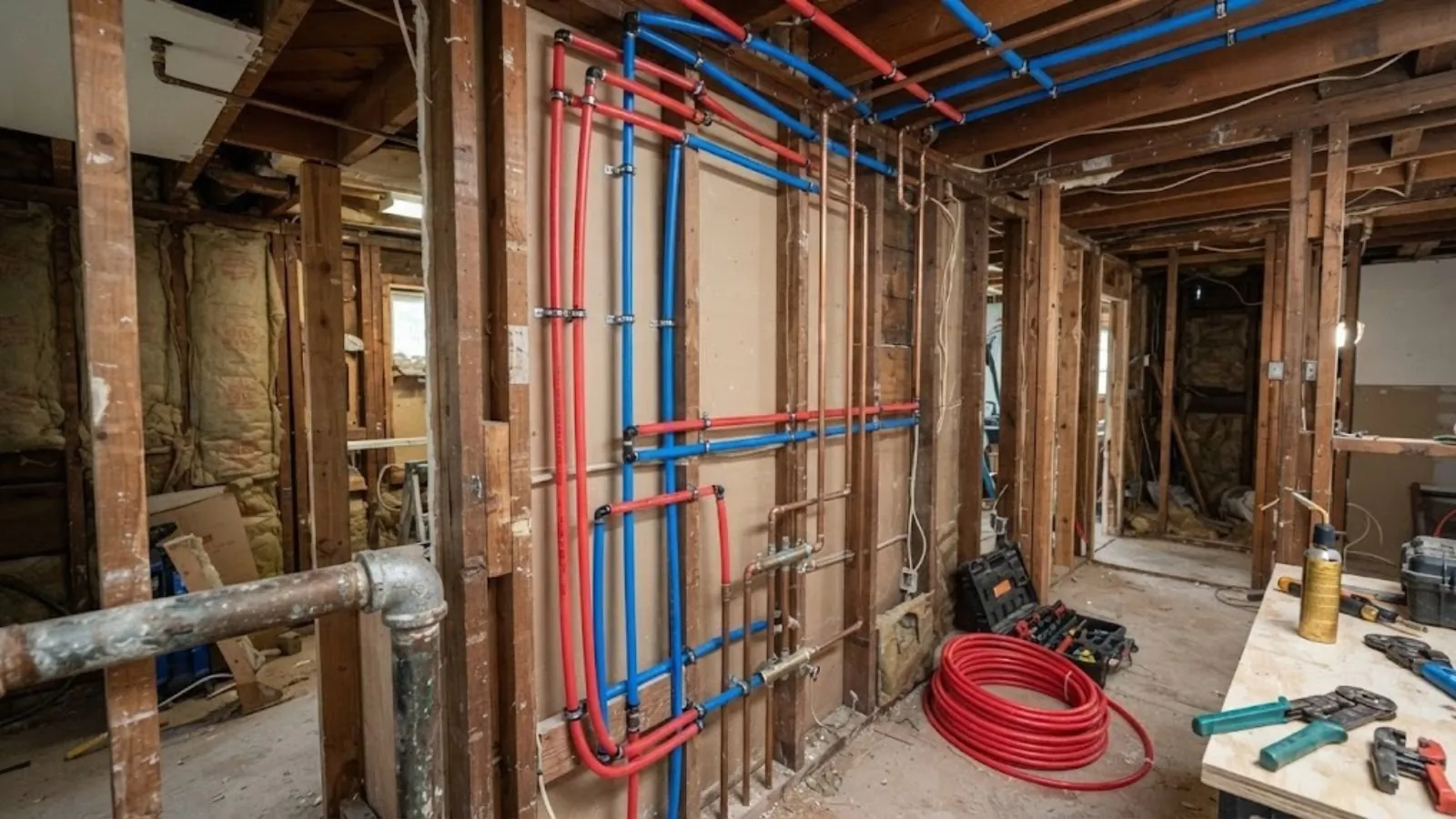
When repiping makes sense
A single leak does not justify repiping. A pattern does. Two or three leaks in a few years, discolored hot water, falling pressure and visible corrosion at multiple joints all point to a system near the end of its life.
Repiping is also worth considering when you plan a major remodel. Opening walls for another purpose is the cheapest time to replace the pipes inside them, and it avoids paying twice for drywall repair.
Replacement materials compared
Each material has a place. The choice depends on the house and the budget.
| Material | Strengths | Tradeoffs |
|---|---|---|
| PEX | Flexible, fewer joints, fast to install, resists scale and freeze damage | Not for direct sunlight, needs the right fittings |
| Copper | Long track record, rigid, heat tolerant | Costs more, labor-intensive, can pit in some water |
| CPVC | Resists corrosion, lower cost | Brittle with age, less flexible |
| Mixed approach | PEX in walls with copper at the water heater | Needs proper transition fittings |
| Manifold system | Each fixture has its own shutoff at a central panel | More tubing, but easy isolation |
| Reroute through attic | Avoids cutting a slab | Needs attic access and insulation |
Ask which fittings and what warranty the plumber uses. Fitting quality matters as much as tubing.
How a repipe project runs
A good project is planned so you are not without water for long.
- STEP 01
Survey and written scope
The plumber inspects the system, identifies the pipe material and walks the layout with you.
- STEP 02
Permit and schedule
Permits are pulled where required, and a schedule is set so water is off for the shortest possible time.
- STEP 03
Rough-in
New lines are run through the attic, crawlspace or walls, with access holes kept small.
- STEP 04
Connect and test
Fixtures are reconnected, the system is pressure tested and an inspection is passed.
- STEP 05
Repair access holes
Drywall patching is handled by the plumber or a drywall contractor you arrange.
Questions to ask before you sign
A repiping bid should answer these in writing:
- Which material will be used and what brand of fittings?
- How many access holes will be cut, and who repairs them?
- How long will the water be off each day?
- Is the permit included, and who schedules the inspection?
- What does the warranty cover, and for how long?
Compare at least the scope and the warranty, not just the price.
Huntersville homes: what the building years suggest
Huntersville's population grew from 3,014 in 1990 to 61,376 in 2020, so most of its housing was built in the last few decades. Many of those homes have copper, CPVC or PEX supply lines, and polybutylene was used widely in the 1980s and early 1990s elsewhere in North Carolina.
That means an older Huntersville home, especially one built before the mid-1990s or moved into a family after a purchase, deserves a pipe material check. A plumber can identify the material in an attic or crawlspace in a few minutes, and the answer decides whether you need a repair or a plan.
Repiping is permitted work, and the new lines are built to the state plumbing code, the International Plumbing Code (IPC) with North Carolina amendments. Ask the plumber which pipe material and support spacing the inspector will check.
Pressure, water quality and your fixtures
New pipe restores flow, which is why many homeowners notice stronger pressure after repiping. If pressure was already high, a pressure regulator protects the new lines and your fixtures.
Charlotte Water's posted analysis lists soft water at about 39 ppm hardness, so scale is not the main pipe problem here. Corrosion from age, joints and installation faults matter more. Read how this plays out in pipe repair when you want to compare a patch with a replacement.
What affects the price of repiping
Repiping is priced by scope and difficulty, not by a flat per-fixture figure.
- Size of the houseMore bathrooms, floors and fixtures mean more pipe.
- MaterialPEX is generally the lower-cost choice, and copper costs more.
- AccessAttic and crawlspace runs are easier than a house with finished walls and a slab.
- Permit and inspectionFees and the plumber's time at the inspection are part of the project.
- Wall repairPatching and painting are separate and can be a sizable part of the budget.
Insurance does not usually pay to replace aging pipes. It may cover damage from a sudden failure. Keep inspection and repair records.
Want your real number? Call (704) 951-1635 and describe the job.
Whole House Repiping questions in Huntersville
Repeated leaks, rust-colored water, low pressure and visible corrosion are the main signs. A plumber can inspect the lines and tell you the material and condition.
A typical single-family home takes several days, depending on size and access. The plumber plans so the water is off for the shortest time each day.
Usually not. You may be without water during the work hours. Ask your plumber for a daily schedule.
Both work. PEX is faster and handles movement and freezing better. Copper has a long record. The best choice depends on your home and budget.
Mecklenburg County says plumbing alterations require a permit. Confirm your project with Code Enforcement at 980-314-2633.
Yes. A plumber can replace the worst runs first. Ask for a quote on the whole house too, so you can compare.
Describe the leaks and the age of the house, and we will outline a repipe plan. Call (704) 951-1635.