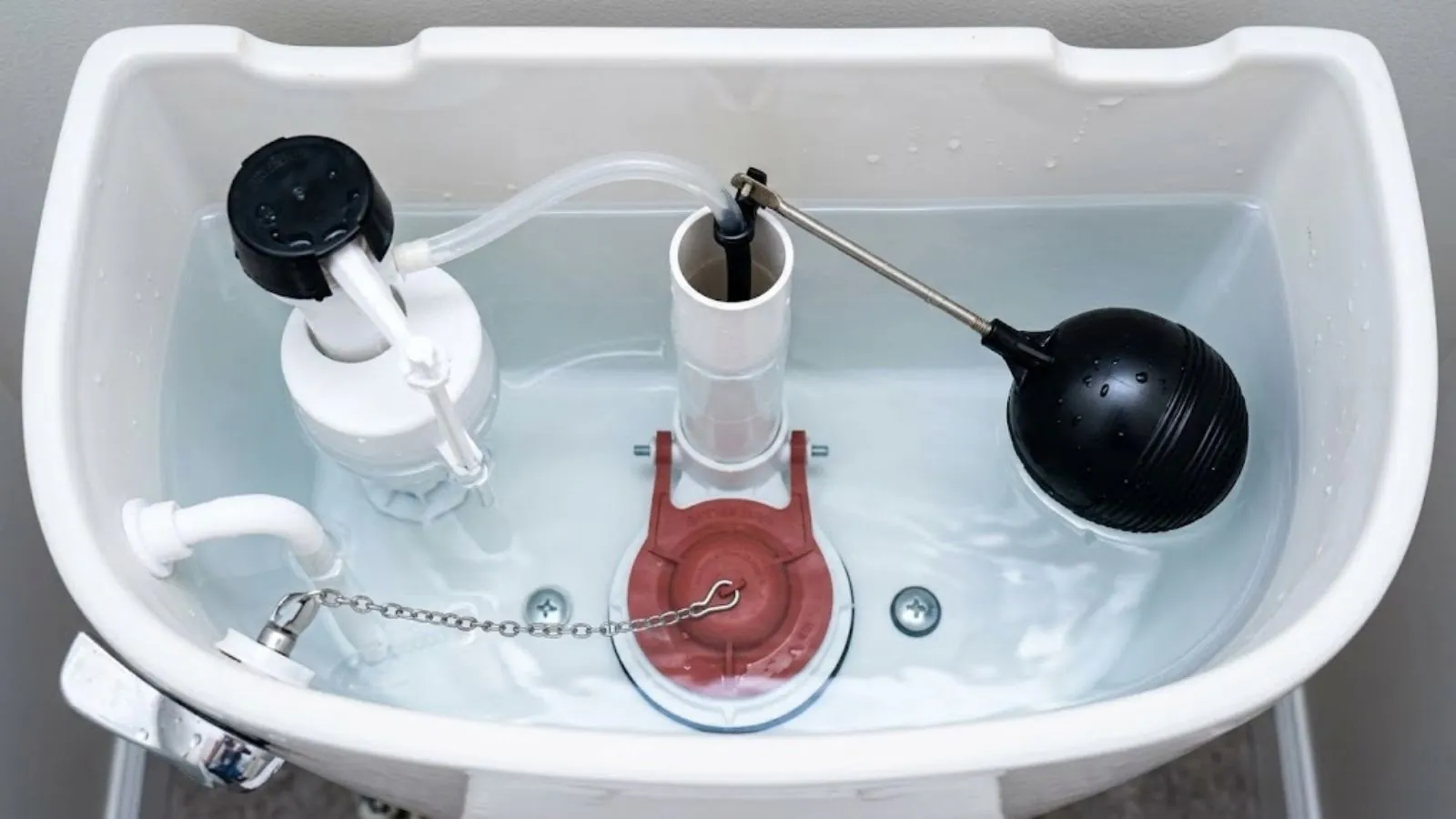
How a float ball works
When you flush, the tank empties and the float ball drops. The fill valve opens and water refills the tank. As the water rises, the ball rises with it, and when the ball reaches the right height, the arm closes the valve.
Problems appear when the ball takes on water and sinks, when the arm is bent or when the valve itself no longer shuts. Each problem has a different symptom, and most are visible if you lift the tank lid and watch a flush.
Symptoms and fixes
Lift the tank lid and match what you see.
| What you see | Cause | Fix |
|---|---|---|
| Water keeps running after the tank is full | Float set too high or the valve is worn | Bend the arm down, replace the valve if it persists |
| Water pours into the overflow tube | Float sitting too high | Lower the float arm |
| The ball has water inside | A crack lets the ball fill and sink | Replace the ball |
| Weak flush, low water in the tank | Float set too low | Raise the float arm slightly |
| Hissing sound after the flush | A worn fill valve seal | Replace the fill valve |
| Toilet refills now and then by itself | Flapper leaking | Replace the flapper |
Test the flapper and the float together. A leaking flapper can make a toilet run even when the float is fine.
How to adjust or replace the float
Shut the supply valve first.
- STEP 01
Close the supply valve
Turn the valve behind the toilet clockwise and flush to drain the tank.
- STEP 02
Look at the float
Check the ball for cracks and water, and check the arm for bends.
- STEP 03
Adjust or replace
Bend the arm gently or turn the adjustment screw. If the ball is full of water, unscrew it and install a new one.
- STEP 04
Refill and observe
Open the supply valve and watch the water rise. It should stop about an inch below the overflow tube.
- STEP 05
Flush and check
Flush twice and look for leaks at the base and the supply connection.
Why many people swap to a modern fill valve
A float ball setup is old. These reasons favor an upgrade:
- A modern fill valve is quieter and shuts off more reliably.
- Many are adjustable by a single screw or a clip.
- The part is inexpensive and installs in minutes.
- It often uses a cup float that is less likely to sink.
- It can reduce the water wasted by a slow leak.
Replace the supply line at the same time if it is old, since the fill valve connection is already apart.
Why a running toilet matters
A toilet that runs in the night can waste a large amount of water without any noise you can ignore. You will not see the waste on the toilet, but you will see it on the bill.
A simple check is to put a few drops of food coloring in the tank and wait fifteen minutes without flushing. If color shows in the bowl, the flapper is leaking. If the water is rising to the overflow tube, the float or the fill valve is the problem.
Beyond the float: when the toilet needs more
If the toilet still runs after a new float and a new flapper, the problem may be a cracked overflow tube, a damaged flush valve seat or a tank bolt leak. Those are usually quick repairs for a plumber.
If the toilet is very old, cracked or constantly repaired, a new one may be the better choice. See our toilet repair page to compare repair and replacement.
Huntersville note: meter and bill checks
Charlotte Water's customer service line is 311 or 704-336-7600. If your bill has risen without explanation, check the toilets first, then do a meter test with all fixtures off. A toilet that leaks a thin stream can be the whole story.
Mecklenburg County Code Enforcement says permits are required for the installation, extension, alteration or general repair of plumbing systems. A float or fill valve swap is a minor repair, but if you are moving a toilet or opening a floor, call 980-314-2633 to ask.
Fill valves in toilet tanks are listed products, and the state plumbing code, the International Plumbing Code (IPC) with North Carolina amendments, governs how the tank is supplied. Buy a current fill valve, and ask the plumber if you want to know which code section covers it.
Parts to keep on hand
A toilet repair kit with a fill valve, a flapper and a supply line costs little and fits most standard toilets. Keep the old parts until the new ones work, so you can compare them if something does not fit.
Write the toilet's brand and model on the inside of the cabinet door under the sink. If you ever need a part or call a plumber, that note answers the first question.
Toilet help in Cornelius
Cornelius homes use the same tank parts and face the same running-toilet bills. Our Cornelius page describes how we serve that town, and the service areas page lists the rest.
Reading the water level correctly
A tank should fill to a mark about an inch below the top of the overflow tube. Many tanks have a line molded into the porcelain. If the water sits above the tube, the toilet drains constantly into the bowl.
If the level is too low, the flush is weak, and you may be tempted to hold the handle down. Setting the level correctly fixes the flush and cuts the water the toilet uses.
Old toilets and efficiency
Toilets with float balls are often the older, higher-flow models. If yours is a few decades old, it may use much more water per flush than a modern one. A new toilet can lower the water bill and reduce the repairs.
A plumber can tell you whether the toilet is worth keeping. If the tank, the bowl and the mounting are sound, a new fill valve and flapper bring it back to life at low cost.
Huntersville questions: Toilet float ball repair
It rises with the water and shuts off the fill valve at the right level.
Common causes are a float set too high, a worn fill valve or a leaking flapper. Lift the lid and watch the water level.
Yes. Gently bend the arm or turn the adjustment screw so the water stops below the overflow tube.
A cracked ball can be replaced alone. If the valve is old or hisses, replace the valve.
Add food coloring to the tank and wait fifteen minutes. Color in the bowl means a leak.
Check Charlotte Water's meter with all fixtures off. If it moves, call 311 or a plumber. Toilets are a common cause.
Describe what the toilet is doing and how old it is, and we will say what to try. Call (704) 951-1635.