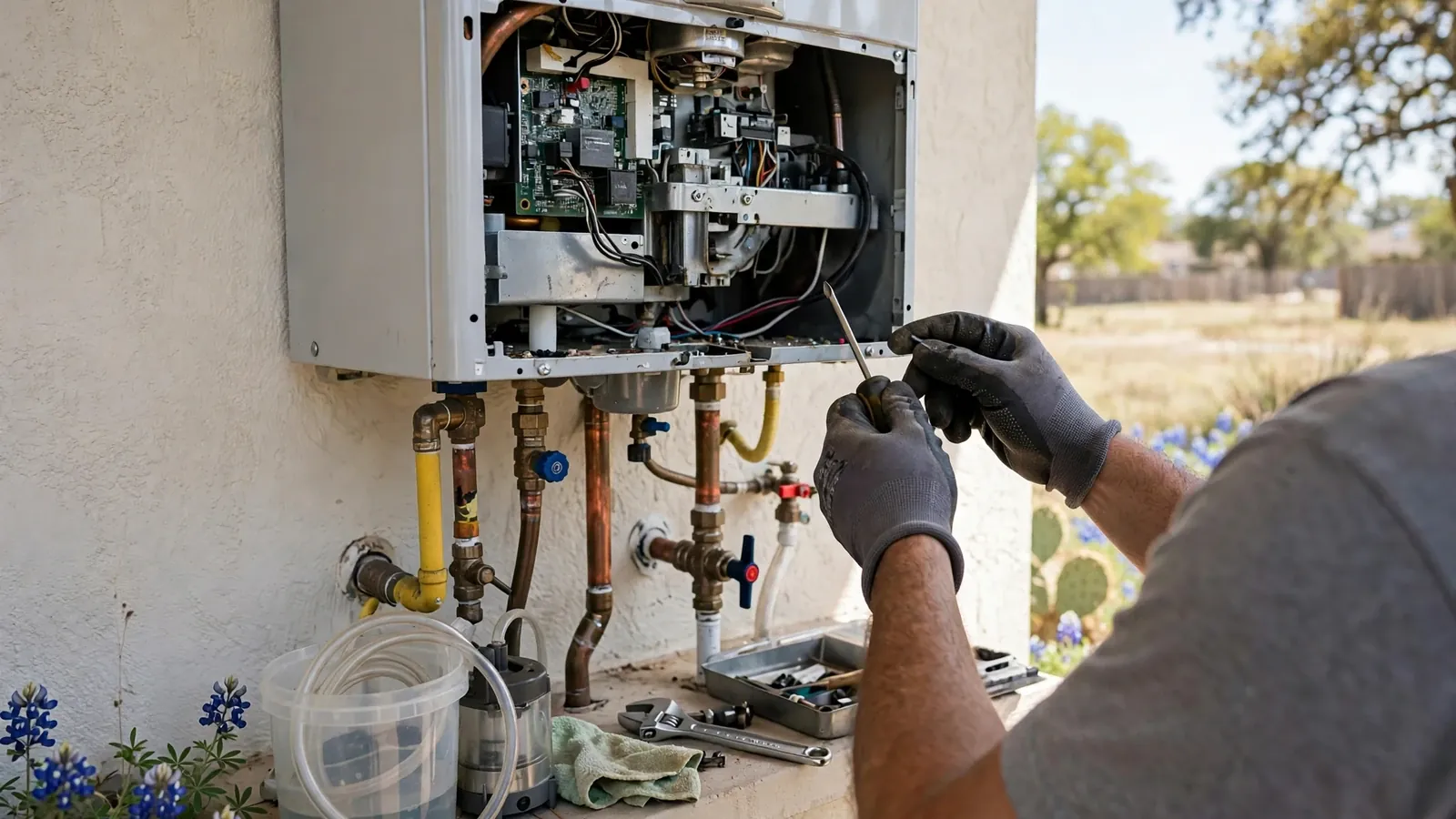
Why homeowners choose an outdoor location
An outdoor tankless unit removes the heater from the garage, closet or attic. It also makes venting simple, since combustion air and exhaust are handled at the wall. In a house with a crowded utility room, that can be the difference between a clean install and a rework.
It is not the right choice for every wall. The unit needs a spot with the right clearances, a gas line that reaches it and a plan for cold weather. If the best wall is far from the bathrooms, you may trade a simple vent for a long hot water wait.
What an outdoor install requires
Each item is a decision to confirm before ordering the unit.
| Item | What to check | Common mistake |
|---|---|---|
| Unit rating | The model is listed for outdoor mounting | Using an indoor unit outside |
| Gas supply | Pipe size matches the unit's maximum demand | Reusing a small line from a tank heater |
| Clearances | Space from windows, doors, vents and the ground | Mounting under a window or over a walkway |
| Freeze protection | Built-in heaters, insulation and a drain-down plan | Assuming the unit is freeze proof |
| Water connections | Isolation valves for flushing, insulated lines | Skipping service valves |
| Condensate drain | A safe path for condensate from high-efficiency units | Letting it drip onto a walkway |
| Power | A receptacle that is weather protected and on a GFCI circuit | A cord run through a window |
Your plumber and the unit's manual set the exact clearances. Follow them rather than a general rule.
How an outdoor install runs
A typical outdoor install takes a day when the gas line is adequate.
- STEP 01
Site check
The plumber looks at the wall, measures clearances and traces the gas and water routes.
- STEP 02
Gas and water rough-in
A larger gas line is run if needed, and new water lines are routed to the wall.
- STEP 03
Mount and connect
The unit is mounted, connected and fitted with isolation valves and a pressure relief device.
- STEP 04
Test and set
Gas connections are leak tested, the unit is fired and the temperature is set and checked.
- STEP 05
Explain the service plan
You get a service interval for flushing and notes on winter protection.
Winter protection in a mild but not frost-free climate
Huntersville does not see long deep freezes, but nights below freezing happen every winter. An outdoor unit and its exposed pipes need protection on those nights. Most outdoor-rated tankless units include electric freeze protection, which only works while the unit has power and the controls are on.
That detail matters. A power outage during a freeze can leave the unit without protection. If you travel in winter, ask the plumber how to drain the unit and the lines, and consider insulating the exposed pipes and fitting a freeze valve where the manufacturer allows.
Questions to ask the installer
These questions separate a careful install from a rushed one:
- Is this model rated for outdoor use, and what clearances does the manual require?
- What size gas line does it need, and does the quote include running it?
- How is the unit protected on nights below freezing, and what happens in a power outage?
- Are isolation valves included so the unit can be flushed?
- Who services the unit, and at what interval?
Huntersville note: soft water and permits
Charlotte Water's posted monthly mineral analysis for treated water at its Franklin plant lists total hardness at 39 ppm, which the USGS places in its soft range. Soft water builds scale slowly, so a tankless unit here may need flushing less often than in a hard-water region. Follow the manual's interval and ask the plumber to note when yours is due. Your own tap may be served from a different plant, so test it if you want certainty.
Mecklenburg County Code Enforcement says plumbing installation, extension, alteration or general repair requires a permit, and gas work may have its own steps. Call 980-314-2633 to confirm what your tankless project needs, and ask your plumber who pulls the permit.
Outdoor gas appliances are installed under the state plumbing code, the International Plumbing Code (IPC) with North Carolina amendments, and the manufacturer's manual. Where the manual's clearances are stricter, follow the manual.
Noise, exhaust and the neighbors
An outdoor unit hums and exhausts warm air at the wall. Mounted below a bedroom window or next to a neighbor's patio, it can become an annoyance. Place it where the sound and the exhaust go somewhere harmless, and keep it clear of vents that could draw the exhaust back inside.
Ask the installer to show the clearance from windows, doors and the property line before the unit is ordered. A sketch on paper costs nothing and avoids a move later.
Planning in Cornelius and nearby towns
Lake homes in Cornelius often have a long run from a garage wall to the far bathrooms, which makes the position of an outdoor unit more important. Our Cornelius page covers how we serve that town, and the service areas page lists the rest.
When an exterior install is not the best idea
If the only available wall faces a patio where people sit, the unit's sound and exhaust may bother you. If the house has no gas on that side, the cost of extending a line may outweigh the savings. If the HOA limits what can be visible from the street, you need written approval first.
In those cases an interior install with a sealed vent, or a different technology, may be easier. Our water heater installation page compares the options, and the plumber can walk the site to give you an honest answer.
Maintenance you cannot skip
An outdoor tankless unit still needs yearly attention. The inlet filter needs cleaning, the heat exchanger needs flushing as the manual directs and the vent termination needs to stay clear of leaves, wasp nests and spider webs. Outdoor units attract all three.
Keep a note of the service dates. Many manufacturer warranties require proof of maintenance. If an error code appears, write it down and call for a diagnosis instead of resetting the unit repeatedly, which can hide a real problem.
Huntersville questions: Tankless exterior installation
No. Only models rated for outdoor use should be installed outside. The label and manual say so, and the clearances differ from indoor units.
Outdoor-rated units have freeze protection that works while they have power. For long outages or trips in winter, ask your plumber how to drain the unit.
Often yes. Tankless units draw a lot of gas at once, and the plumber sizes the pipe to the unit and the run.
Mecklenburg County says plumbing installation or alteration requires a permit. Confirm with Code Enforcement at 980-314-2633.
Charlotte Water's posted mineral analysis lists total hardness at 39 ppm, which is soft, so scale builds slowly. Still follow the manual and the plumber's advice for your unit.
On a wall with the right clearances from windows, doors and vents, near the gas supply and not over a walkway. The plumber measures before you order.
Describe the wall and the gas line and we will say whether an outdoor unit fits. Call (704) 951-1635.