What the cleaner does
As water is heated, minerals can come out of solution and form scale on the inside of the heat exchanger. Scale narrows the passages, makes the unit work harder and can trigger error codes for overheating or low flow.
A descaling cleaner is an acid-based solution that dissolves that scale. A pump moves the solution through the unit for the time the manufacturer specifies, and then clean water rinses it out.
Cleaner choices
Choose the solution your manufacturer allows.
| Option | How it works | Considerations |
|---|---|---|
| White vinegar | A mild acid that dissolves some scale | Common and cheap, but less strong, and may take longer |
| Manufacturer descaling solution | Formulated for the heat exchanger | Matches the warranty, often the best choice |
| Citric acid solutions | A stronger organic acid | Check the manual before using |
| Strong acids such as hydrochloric | Dissolve scale quickly | Can damage seals and parts, avoid unless the maker says so |
| No cleaner, filter only | A sediment filter stops particles | Does not remove dissolved scale |
Always check the manual. Using a solution the maker does not allow can void the warranty.
How a flush works
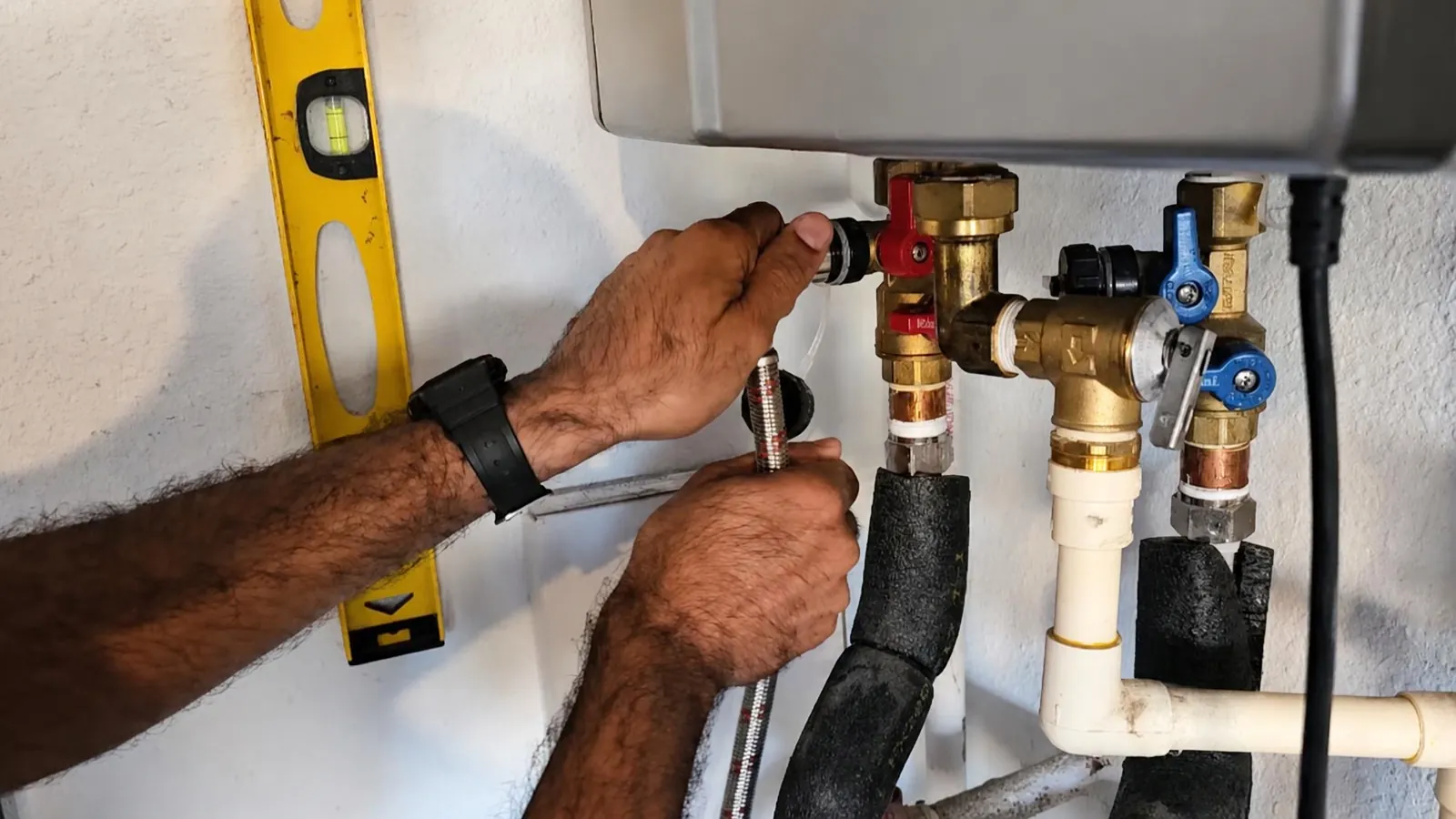
A flush uses a small pump and two hoses connected to the unit's service valves.
- STEP 01
Shut off power and gas
The unit is turned off and the gas and water are closed.
- STEP 02
Connect the hoses and pump
A hose runs from the pump to the cold service valve, and another returns from the hot valve to a bucket.
- STEP 03
Circulate the solution
The solution is pumped through the heat exchanger for the time the manual specifies.
- STEP 04
Rinse thoroughly
Clean water flushes the descaler out, and the inlet filter is cleaned.
- STEP 05
Restart and test
Gas and power are restored, and the unit is run to confirm stable temperature and no codes.
Signs the unit needs a flush
Do not wait for the error code:
- Hot water that turns lukewarm during a long shower.
- An error code for flow, overheating or ignition that returns after a reset.
- Reduced flow at the tap compared with a few years ago.
- Popping or rumbling sounds as the unit heats.
- Water that takes longer to reach full temperature.
Many units have an inlet screen. If the filter is clogged with debris, the unit may show low flow even if the heat exchanger is clean.
Huntersville note: how soft water changes the schedule
Charlotte Water's posted monthly mineral analysis for treated water at its Franklin plant lists total hardness at 39 ppm. The USGS places water under 60 mg/L in its soft range. Soft water forms scale slowly, so a tankless unit here may need flushing less often than the common once-a-year advice written for hard-water regions.
That does not mean never. Follow the manual's interval, check the inlet filter and keep a record of service. Your own tap may be served from a different plant, so test it if you want certainty. Mecklenburg County Code Enforcement at 980-314-2633 can tell you whether any permit applies to work beyond a flush.
Service valves and the condensate drain on a tankless unit are part of the install under the state plumbing code, the International Plumbing Code (IPC) with North Carolina amendments, and the maker's manual. If yours has none, a plumber can add them.
Record keeping for the warranty
Many tankless manufacturers ask for proof of maintenance if you make a warranty claim. Keep the date of each flush, the solution used and the name of whoever did the work. A photo of the pump setup and the rinse water helps.
Put the next due date on a calendar or inside the unit's cover. A unit that is serviced on a schedule tends to need fewer emergency calls.
Tankless service in Cornelius
Cornelius homes with tankless units have the same needs. See our Cornelius page for how we serve that town, and our service areas page for the others.
Error codes that point to scale
A flow error, a temperature error or an overheat shutdown can all trace to scale in the heat exchanger or a clogged inlet filter. The code list in the manual shows which codes are related, and a plumber reads them on the display.
Write down the code, the time and what you were doing. A pattern, such as errors only in long showers, tells the plumber whether the flow or the heat is limited.
Running the flush safely
Descaling solution is an acid. Wear gloves and eye protection, work in a ventilated space and dispose of the used solution as the label directs. Never mix a cleaner with another cleaner.
Do not run the unit during a flush. The pump circulates the solution while the burner is off. Restarting too early can damage the pump or the unit. A plumber handles these steps every day, and a careless homeowner can miss one.
Service valves make flushing simple
A tankless unit with isolation valves can be flushed without cutting any pipes. Without them, a plumber has to install them first. The valves are small and inexpensive, and they pay for themselves on the first service.
If your installer left them out, ask for them at the next visit. See our water heater installation page for how we handle planned work on heaters.
Doing it yourself or hiring a plumber
A flush is within reach of a careful homeowner with a pump, hoses and the manual. The risks are working around gas and hot water, using the wrong solution and missing the rinse.
A plumber also checks the vent, the condensate drain and the gas pressure while the unit is open. If the unit shows an error code or has not been flushed in years, a service visit is a wise choice.
Huntersville questions: Tankless heater cleaner
Use the descaling solution the manufacturer allows. White vinegar is a common mild option, and the manual sets the time.
Follow the manual. Charlotte Water's posted mineral analysis lists soft water at 39 ppm, so scale builds slowly, but check the inlet filter and keep a record.
Many people do, but check the manual first. Some makers specify their own solution.
They make it far easier. Without them, a plumber can add them.
Scale can build up and trigger error codes, reduce flow and shorten the life of the heat exchanger.
Not entirely. Soft water slows scale, but the filter, the vent and the unit still need attention.
Send us the model and the last service date and we will outline what a flush involves. Call (704) 951-1635.