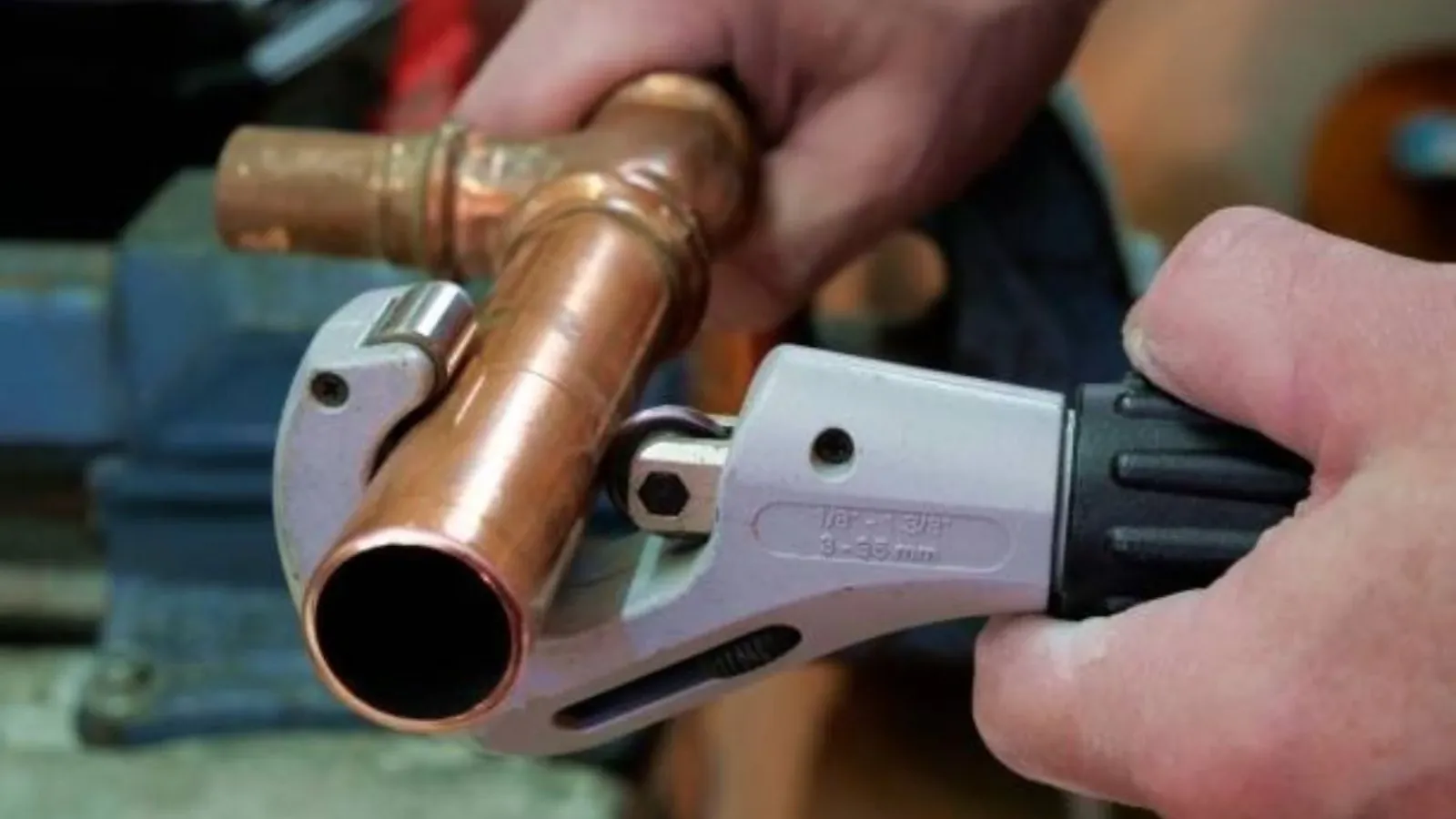
What to do first when a copper pipe bursts
Do these in order. They limit damage faster than the repair does.
- STEP 01
Close the main valve
Turn the main shutoff clockwise. If water still flows, close the meter valve and call.
- STEP 02
Open the lowest faucet
Draining the lines reduces pressure and stops the spray.
- STEP 03
Turn off the water heater
Switch off the breaker or the gas control so the heater does not run dry.
- STEP 04
Protect the electrics
If water is near the panel or outlets, stay clear and call. Do not stand in water to reach a breaker.
- STEP 05
Document the damage
Take photos of the break, the water and any wet materials.
What a copper burst looks like
Copper bursts in two common ways. A frozen pipe splits along its length, usually in a short section where the ice formed. A corroded pipe or a failed solder joint blows out at a point and leaks at a fitting.
The cause matters because it points to the repair. A split from a freeze is often a single section. A burst from corrosion may mean the pipe is worn along its length, and replacing only the burst section may leave a second leak a few feet away.
Repair methods for copper
A plumber chooses the method that fits the pipe and the location.
| Method | How it works | Best when |
|---|---|---|
| Cut and sweat a coupling | Cut out the damaged section and solder a new piece with couplings | Accessible pipe, a dry work area |
| Push-to-connect fitting | A fitting slides over the pipe ends and seals with an internal gripper | Tight spaces where soldering is unsafe |
| Compression fitting | A nut and sleeve clamp the pipe | Temporary or accessible repairs |
| Replace with PEX | Transition from copper to PEX with approved fittings | Longer sections or hard-to-reach runs |
| Replace a longer run | Remove the failed run and install new pipe | Multiple pinholes or heavy corrosion |
| Pipe clamp or sleeve | A temporary clamp to stop a leak | Short-term only |
A temporary clamp is not a permanent repair. Ask the plumber when it should be replaced.
Signs one repair is not enough
If these apply, ask for a quote on more than the burst section:
- Green or white crust at several joints.
- Pinhole leaks that have appeared more than once.
- Rust-colored or metallic-tasting water.
- Pipes more than a few decades old with a history of repairs.
- Low pressure that has gotten worse over time.
See our whole house repiping page if you are weighing a larger replacement.
Why freezing happens in a mild climate
Huntersville winters are mild, but nights below freezing occur, and pipes in attics, crawlspaces and exterior walls can freeze. A pipe that is not insulated, or one that runs along an outside wall, is the usual victim.
Insulate exposed pipes, seal gaps where cold air gets in and let a faucet drip on a very cold night. If you travel in winter, set the heat to a safe level and know where the main shutoff is.
Huntersville note: permits and a licensed plumber
Mecklenburg County Code Enforcement says plumbing installation, extension, alteration or general repair requires a permit. A simple section swap may or may not, depending on scope, so call 980-314-2633 to ask.
North Carolina requires a license to engage in plumbing contracting. Search the plumber at public.nclicensing.org, the State Board of Examiners of Plumbing, Heating and Fire Sprinkler Contractors license lookup. If a break is behind a wall, call 811 only for digging outdoors.
Pipe, fittings and transitions used in a repair follow the state plumbing code, which is the International Plumbing Code (IPC) with North Carolina amendments. That is why a copper repair next to PEX uses listed transition fittings.
Cleaning up after the water
Remove standing water quickly. Use towels, a wet vacuum and fans, and pull up soaked rugs and padding. Wet drywall and insulation hold water longer than you expect, and mold can begin in a day or two.
Open cabinet doors and lift baseboards if you can do it safely. A restoration company has meters and drying equipment for larger jobs, and a plumber handles the pipe.
Burst pipes in Cornelius
Cornelius homes face the same freeze and corrosion risks. Our Cornelius page explains how our 24/7 line serves that town, and our service areas page lists the others.
Why soldering needs a trained hand
A sweated copper joint needs clean pipe, flux, the right heat and a dry joint. Water in the pipe keeps the temperature down so solder will not flow, which is why the line is drained and the pipe is dried before the repair.
A poor joint can look fine and leak days later. A plumber tests the joint under pressure before closing the wall, and a push-fit fitting is sometimes the safer choice when soldering would be near wood or insulation.
Copper, PEX and mixing materials
Many Huntersville homes built in recent decades use PEX or CPVC for some or all supply lines. A plumber repairing a copper pipe next to PEX uses fittings made for the transition. Mixing metals without the right fittings invites corrosion.
Before any repair, ask what the pipe is made of and what the replacement section will be. A short answer that names the material and the fitting is a good sign.
After the repair
Open the faucets slowly to purge air, and check every joint for drips over the next day. Dry wet materials as soon as possible, because wet drywall and insulation can grow mold within a couple of days.
Call your insurance company early. Photographs, the plumber's findings and the receipts all help. Many policies cover sudden water damage but not the failed pipe itself.
Huntersville questions: Repair a burst copper pipe
Close the main water valve, open the lowest faucet and turn off the water heater. Then call a plumber.
Often yes. A plumber cuts out the damaged section and installs a new piece. If the pipe is corroded along its length, replacing more may be wiser.
A single accessible section commonly takes a few hours. A pipe behind a finished wall takes longer.
It depends on the scope. Mecklenburg County Code Enforcement at 980-314-2633 can tell you.
Many policies cover sudden water damage but not the pipe itself. Photograph the damage and call your carrier.
Only if digging is needed outside. For a pipe inside the house, no.
Shut the main, then tell us where the pipe split and we will send help. Call (704) 951-1635.