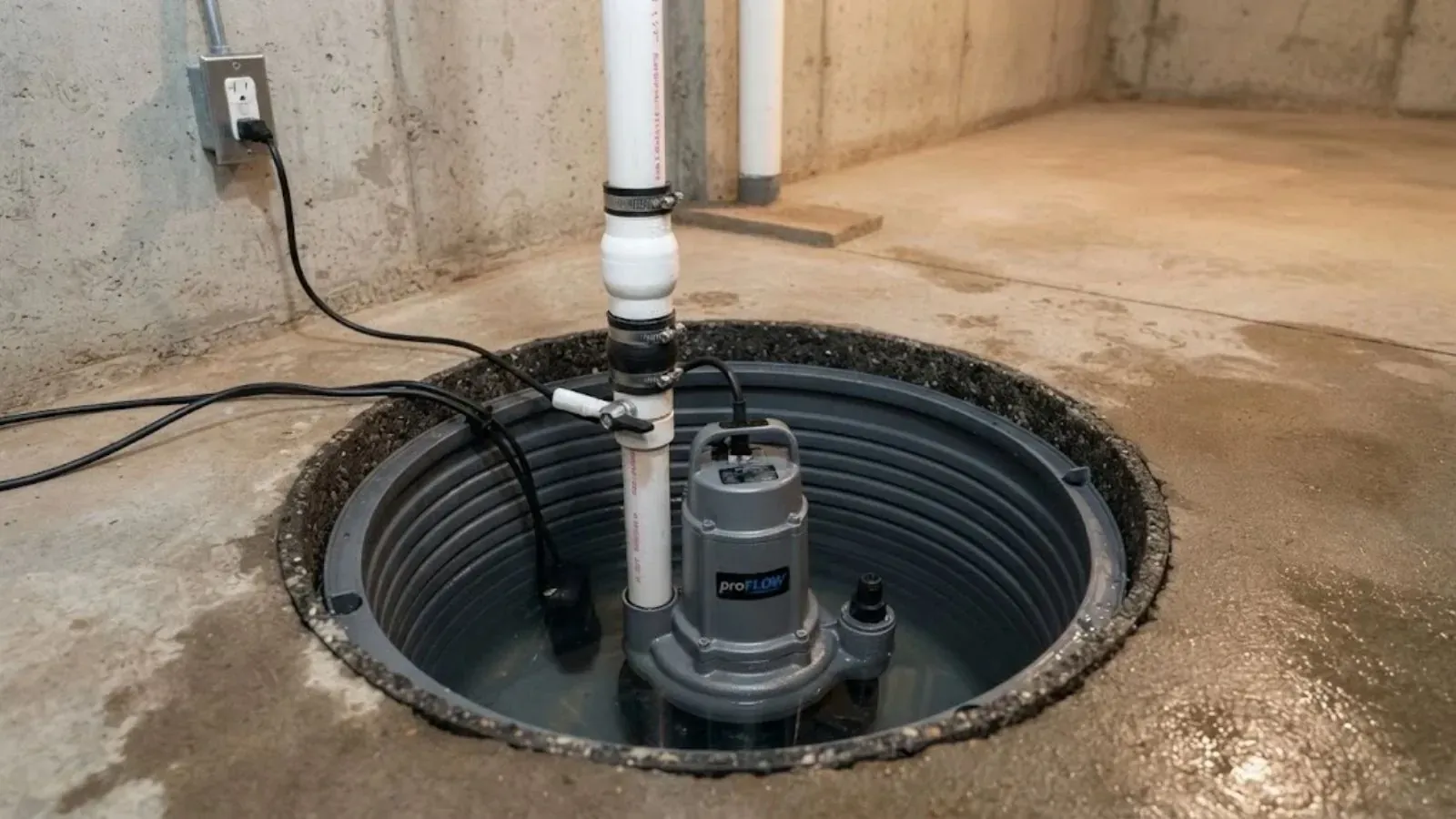
Find the real low point
A sump pump only works if water reaches it. Water follows gravity, so the pit has to sit at the lowest place where water gathers. In a basement that is often near a corner or along a wall where the floor slopes. In a crawlspace it may be near the entry or a depression in the soil.
Watch where water appears after a heavy rain, or pour a bucket of water on the floor and see which way it runs. The pit goes where the water naturally collects, not where the plumbing is convenient.
What the installation needs
Each piece has a job. Missing one causes the usual failures.
| Part | What it does | Common mistake |
|---|---|---|
| Pit or basin | Holds water until the pump removes it | Too shallow or not below the floor level |
| Pump | Moves water out of the pit | Undersized for the volume |
| Float switch | Starts and stops the pump | Jammed against the wall of the pit |
| Check valve | Stops discharged water from flowing back | Skipped, so the pump cycles constantly |
| Discharge line | Carries water away from the foundation | Dumps water next to the house |
| Power and backup | Runs the pump during storms | No backup for a power outage |
Plan for the power failing during the storm. A battery backup or a water-powered backup is worth discussing.
How a sump pump install goes
A typical install in a slab or basement follows this order.
- STEP 01
Choose the spot
Mark the lowest point and check for pipes and wires below the floor.
- STEP 02
Cut and dig the pit
The slab is cut, a hole is dug and the basin is set level with gravel around it.
- STEP 03
Set the pump
The pump sits on a firm base, away from the pit wall, with the float free to move.
- STEP 04
Run the discharge
A line with a check valve runs outside and ends away from the foundation.
- STEP 05
Test
The pit is filled with water to confirm the float starts the pump and the check valve holds.
Where the water should and should not go
The discharge point matters as much as the pump:
- It should end well away from the foundation so water does not return to the pit.
- It should not flow onto a neighbor's lot or across a sidewalk where it freezes.
- It should not connect to a sanitary sewer line or a house drain unless your utility says it is allowed.
- It should not discharge into a septic system.
- It should be protected from freezing at the outlet where possible.
Ask your water utility and your town about where discharge is allowed before you run the line.
Is it a sump problem or a plumbing leak
Water in a crawlspace or a low spot is not always groundwater. A leaking supply line, a failed water heater, a bad drain or an irrigation line can fill a low spot just as well. A sump pump hides the symptom and leaves the leak running.
Before you install a pump, shut off all water in the house and see whether the water stops. Read our leak detection page for the meter test that tells you whether the water is coming from the pipes.
Huntersville note: who to ask about discharge and permits
Charlotte Water serves Huntersville, Cornelius and Davidson with water and sewer service, and its customer service line is 311 or 704-336-7600. Ask the utility where a sump discharge may go for your address, and do not tie it into a sanitary sewer line or a cleanout unless the utility says so.
Mecklenburg County Code Enforcement says plumbing installation, extension, alteration or general repair requires a permit, and electrical work for a pump may have its own. Call 980-314-2633 to confirm what your project needs.
Where a sump discharge may go is a question for your utility and your town, and the plumbing and electrical work for the pump follows the state plumbing code, the International Plumbing Code (IPC) with North Carolina amendments, and the electrical code.
Sizing the pump to the problem
A pump has to move more water than the pit receives at the worst moment. A small pump on a big problem runs constantly and fails early. A large pump on a small problem cycles too often.
Ask the contractor how they chose the pump size, and what rain event they sized it for. A good answer refers to the water you actually see, not a catalog number.
Water problems around Cornelius
Lake-area lots in Cornelius often slope toward the shore, and water behavior differs from lot to lot. Our Cornelius page describes how we serve that town, and the service areas page lists the others.
Maintenance that keeps it working
Test the pump at the start of the wet season. Pour a bucket of water into the pit and check that the float rises, the pump starts and the water leaves. Listen for grinding or rattling.
Clean the pit of silt and debris once a year, and check the discharge outlet for blockage. A pump that runs for a few seasons without a test can fail the first night it is needed. A pump has a life, and an old pump deserves a replacement before a big storm.
When a pump is not the right answer
If water enters through a foundation crack or the soil is saturated, a pump manages the water but does not stop it. Grading, gutters and downspouts that carry roof water away from the house often reduce the load more cheaply than any pump.
A contractor who sees only a pump as the solution may sell you a system you do not need. Ask what is causing the water, and get the answer before you buy.
Huntersville questions: Where to install a sump pump
At the lowest point where water collects, in a pit below the floor level, with a discharge line to a safe place away from the house.
Not unless your utility says it is allowed. Ask Charlotte Water at 311 before connecting a discharge line to any drain or cleanout.
Yes. It stops water in the discharge line from flowing back into the pit when the pump stops.
If your pit fills during storms, a battery or water-powered backup is worth considering.
It can, especially for electrical or plumbing changes. Call Mecklenburg County Code Enforcement at 980-314-2633.
Shut off all water in the house and see if the water stops. If it does not, a plumber can look for a leak.
Tell us where the water collects and we will help sort out leak from groundwater. Call (704) 951-1635.