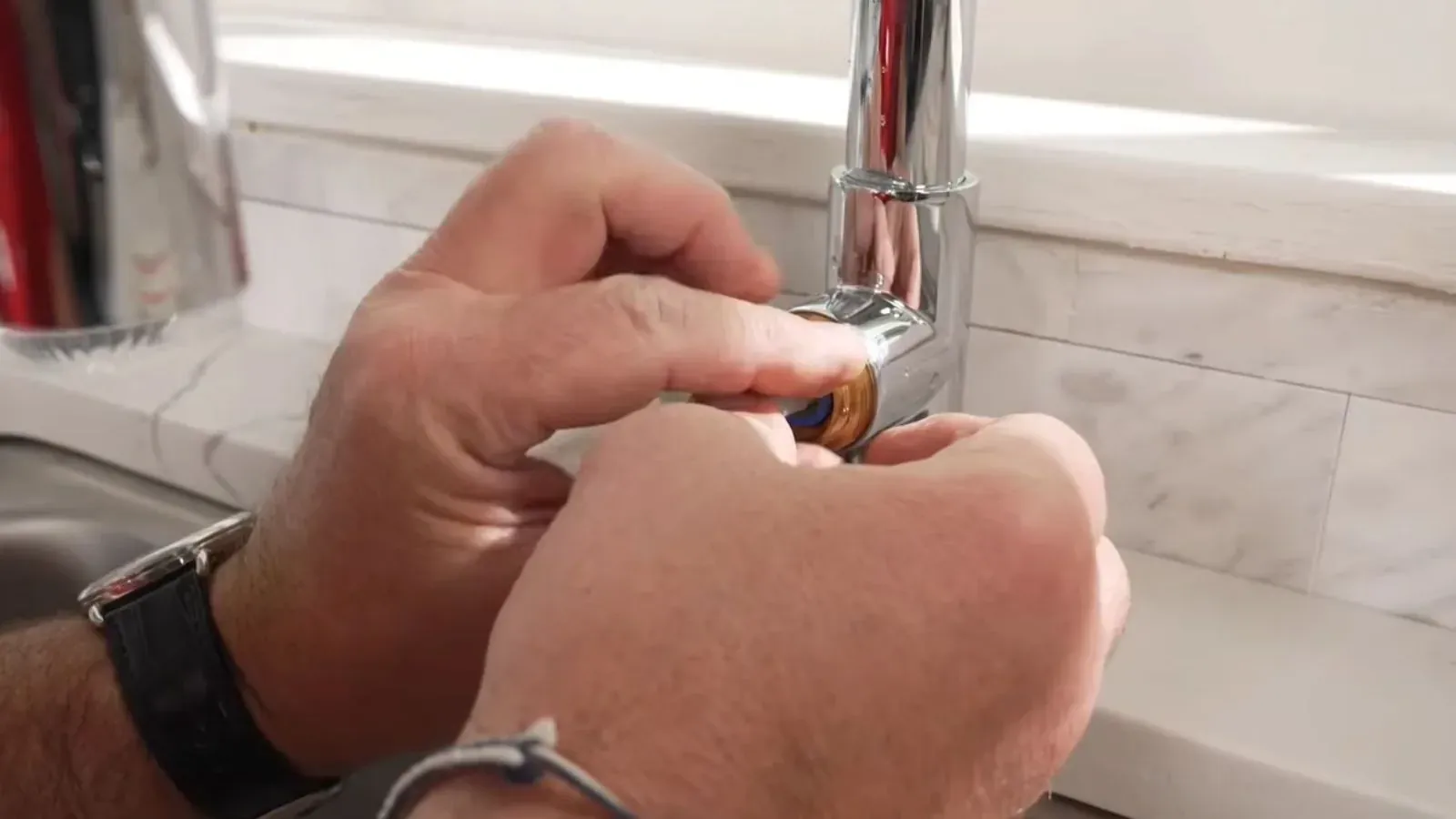
Symptom, cause and fix
Match what you see to the likely cause.
| Symptom | Likely cause | Typical fix |
|---|---|---|
| Drips from the spout when off | Worn cartridge or seat | Replace the cartridge |
| Leaks at the base of the spout | Worn O-rings on the spout swivel | Replace the O-rings |
| Handle is stiff or loose | Mineral buildup or a loose set screw | Clean or tighten, replace the cartridge if rough |
| Water at the base of the handle | Failed cartridge seal | Replace the cartridge |
| Weak flow or spray | Clogged aerator or kinked hose | Clean the aerator, check the hose |
| Water under the sink | Loose supply connection or a leaking hose | Tighten, or replace the supply line |
Find the faucet brand and model before you buy parts. Cartridges vary and many are not interchangeable.
How a faucet repair goes
A plumber follows the same sequence, and you can follow it for a simple fix.
- STEP 01
Shut off the supply
Close the stop valves under the sink. If they will not close, close the main and see fixture repair.
- STEP 02
Open the faucet
Remove the handle, the cap and the retaining nut to reach the cartridge.
- STEP 03
Inspect and replace
Check the cartridge, the O-rings and the seat. Replace worn parts with matching ones.
- STEP 04
Reassemble and test
Reassemble, turn the water on slowly and check for drips at the spout, the handle and the connections.
- STEP 05
Check under the sink
Run the faucet hot and cold and look at every connection for moisture.
The cartridge is the heart of a single handle faucet
A single handle faucet mixes hot and cold water with one cartridge. That cartridge has seals that wear out from use, and wear shows up as a drip, a stiff handle or a handle that no longer holds temperature.
Replacing it is usually the right fix, and the part is not expensive. The challenge is the match. Take the old cartridge to the store or send a photo of the faucet and the label to the plumber so the replacement fits.
Signs a replacement is the better call
A new faucet may be wiser when:
- The faucet body is corroded or pitted.
- The finish is peeling, and the handle wobbles.
- Parts are no longer made for your model.
- You have had several repairs in a short time.
- You want a feature a repair cannot give you, such as a pull-down sprayer or a touchless valve.
A quality faucet can last many years. A cheap one may need frequent repairs, and the repair cost adds up.
The sprayer and the hose
Pull-down and pull-out faucets use a hose that can kink, crack or loosen at the connection. If the spray is weak, the hose may be kinked under the sink behind a cleaning bottle. If water appears under the sink only when you use the sprayer, the hose or its quick connector is leaking.
A hose and a connector are cheap to replace. If the faucet body itself leaks around the swivel, the O-rings are the first suspect. If new O-rings do not help, the body may be pitted.
Huntersville note: water chemistry and your faucet
Charlotte Water's posted monthly mineral analysis for treated water at its Franklin plant lists total hardness at 39 ppm, which the USGS places in its soft range. Soft water leaves less scale inside faucets than hard water, so mineral buildup is a smaller cause of stiff handles here than in many places. Your own tap may be served from a different plant.
Charlotte Water's 2022 water quality report says the average pH of its water is 8.6 and that the utility uses chlorine for disinfection. Chlorine can age rubber seals over time, which is one reason O-rings and cartridge seals wear out on any faucet. Replace worn seals before they leak.
Faucets themselves are listed products, and their supply connections fall under the state plumbing code, the International Plumbing Code (IPC) with North Carolina amendments. Use supply lines rated for the job and replace a stop valve that will not close.
Keep a repair kit, not a pile of parts
A basic kit for a single handle faucet includes a cartridge for your model, a set of O-rings, a small tube of plumber's grease, a hex key set and a pair of pliers with tape on the jaws to protect the finish. Label the bag with the faucet brand and model.
Save the model number from the underside of the faucet or the original box. It shortens the search the next time a part wears, and a plumber can match it quickly if you call.
Faucet help in Cornelius
Cornelius homes have the same faucet wear and the same questions. Our Cornelius page explains how our dispatch line serves that town, and our service areas page lists the others.
Hard-to-reach cartridges and finishes
Some single handle faucets hide the retaining nut under a decorative cap or a set screw that faces the back of the handle. Pry gently with a thin tool wrapped in tape so the finish is not scratched, and keep the set screw in a safe place.
Cartridges that will not budge may be stuck with mineral and rubber residue. A cartridge puller made for your brand removes it without damaging the faucet body. Using pliers on the cartridge can crack the brass, and that turns a small repair into a new faucet.
What to do while the water is off
A kitchen with the water off is hard to use, so plan the repair for a time when you do not need to cook or wash dishes. Fill a pot or two beforehand, and start the work early in the day so the stores are open if you need a part.
If the repair goes beyond a cartridge, a plumber can finish the job the same day in many cases. Tell dispatch what you found, so the right parts are on the truck.
Do it yourself or call a plumber
A cartridge swap is a reasonable weekend task if the stop valves work and you have the right part. Take photos as you go and keep every small part in a cup.
Call a plumber if the stop valves will not close, if the faucet is mounted in a stone countertop that you cannot risk cracking, or if water is already under the sink and the cabinet is soft. A small leak that is ignored becomes a rotted cabinet floor.
Huntersville questions: Single handle faucet repair
Usually the cartridge seals have worn. Replacing the cartridge stops most drips.
Yes, if you can identify the model. Many cartridges are model specific, so check the brand and a part number.
A cartridge or O-ring repair commonly takes under an hour when the stop valves work. A stuck valve or a damaged body adds time.
If it has been repaired before, has a corroded body or a failing finish, replacement is often the better value.
Charlotte Water's posted mineral analysis lists total hardness at 39 ppm, which is soft, so scale is a smaller factor. Seals still wear from use and from chlorine.
Yes. Send the model so we can check the parts and the sink holes before the visit.
Describe the leak and the faucet brand, and we will tell you what the repair likely involves. Call (704) 951-1635.