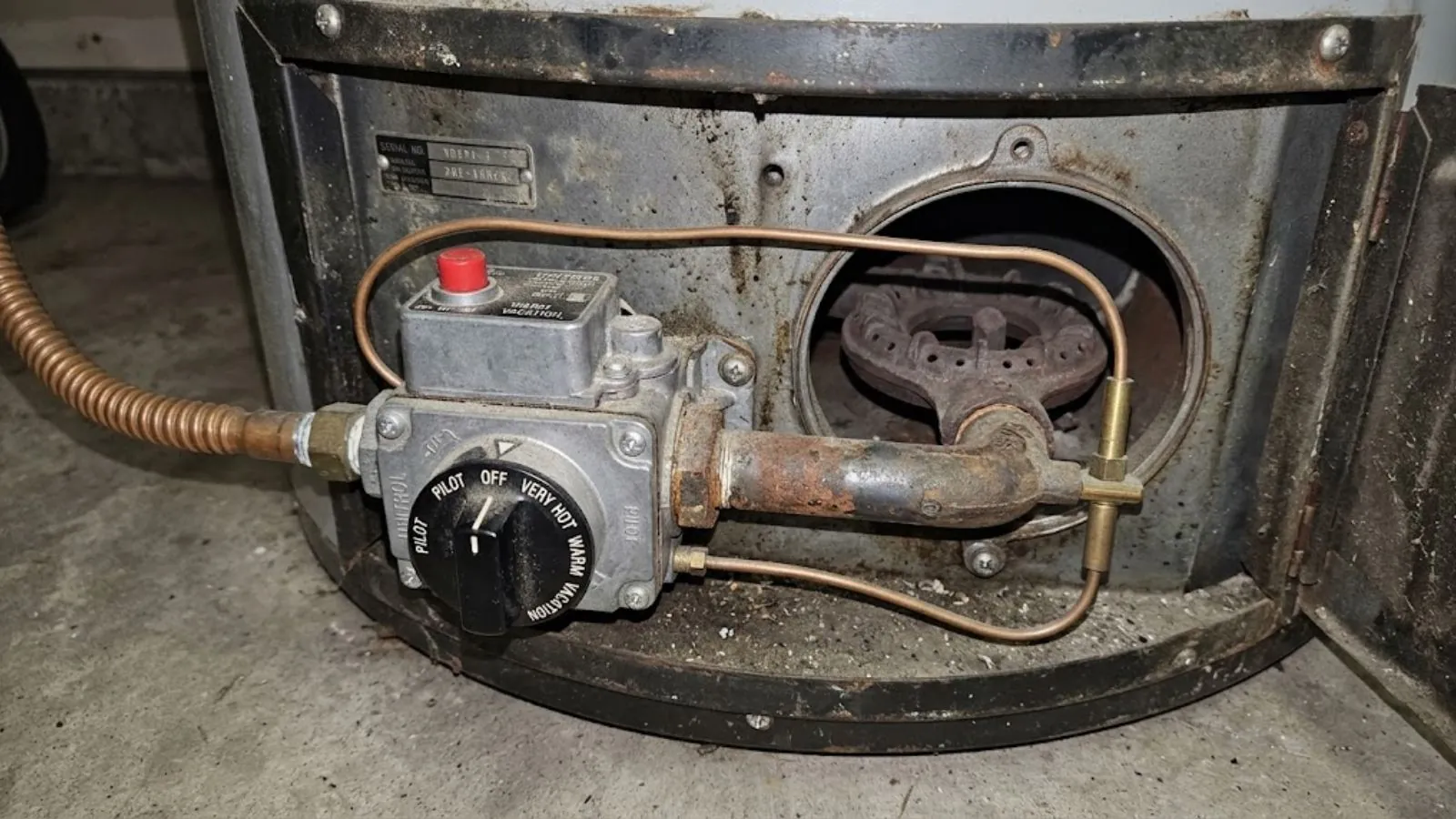
What the gas control valve does
On most residential gas tanks, the thermostat is not a separate part. It is a dial on the gas control valve, a unit that senses water temperature, opens and closes the gas to the burner and shuts the gas off if the pilot goes out.
Because it controls gas, a replacement is a safety job. The valve must seat properly in the tank, the thermocouple or flame sensor must be matched and the gas connection must be tested for leaks. A mistake can leave a leak or a burner that does not shut off.
Symptoms and likely causes
Not every temperature problem is the thermostat. Sort the symptom first.
| Symptom | Likely cause | Repair |
|---|---|---|
| Pilot will not stay lit | Failed thermocouple or a dirty pilot | Replace the thermocouple, clean the pilot |
| Burner does not light, pilot is on | Failed gas control valve | Replace the control valve |
| Water too hot | Stuck gas control or a thermostat out of calibration | Replace the control, check the relief valve |
| Water lukewarm | Sediment, a failing control or a low setting | Flush the tank, test the control |
| Burner cycles on and off | Failing control or a draft problem | Test the control, check the vent |
| Yellow or sooty flame | Poor combustion or a blocked vent | Stop using and call a plumber |
A yellow flame is not a thermostat problem. It can point to carbon monoxide, so call a plumber.
Safety steps before anyone touches the heater
Do these before any repair:
- Turn the gas control dial to off and close the gas shutoff valve on the supply line.
- Let the burner and the tank cool before you touch anything.
- Ventilate the area if you smell gas, and do not use switches or flames. Leave and call 911 if the smell is strong.
- Check that carbon monoxide alarms near sleeping areas are working.
- Photograph the data label so the plumber can match the control valve to the model.
The gas control is not a part to guess on. The wrong replacement valve can be unsafe.
What a replacement visit involves
A plumber follows a specific order.
- STEP 01
Diagnose
The plumber checks the pilot, the thermocouple, the burner and the gas supply before blaming the control.
- STEP 02
Shut off and drain
Gas and water are shut off, and the tank is partly drained.
- STEP 03
Swap the control
The old control is removed and the new one is installed with the right thermocouple and burner tube.
- STEP 04
Leak test
Every gas connection is tested with leak detector solution before the pilot is lit.
- STEP 05
Relight and verify
The pilot is relit, the burner is observed and the water is brought to the set temperature.
Temperature setting and scald risk
The U.S. Department of Energy suggests setting a water heater around 120 degrees Fahrenheit for savings and to reduce scald risk. Households with young children or older adults should be at or below that setting.
If the dial is set correctly but the water is hotter than that, the control has failed or the relief valve is not working. Do not keep using the heater. Hot water at the tap that scalds in seconds is dangerous.
Repair or replace the heater
A new control valve is a reasonable repair on a young tank. On a tank that is old, rusting or leaking, spending money on a control makes little sense, since the next failure is the tank itself.
Ask the plumber for the age from the serial number and for a price on both options. Read our water heater replacement page if you are weighing a new heater.
Huntersville note: gas safety and licensing
North Carolina requires a license to engage in plumbing contracting, and the State Board of Examiners of Plumbing, Heating and Fire Sprinkler Contractors runs a public license search at public.nclicensing.org. Check the plumber there before any gas work.
Mecklenburg County Code Enforcement says plumbing installation, extension, alteration or general repair requires a permit, so ask whether a control replacement needs one. Call 980-314-2633. For a gas smell, call 911 or your gas utility from outside the house.
Gas appliance connections, venting and the relief valve sit under the state plumbing code, which is the International Plumbing Code (IPC) with North Carolina amendments, along with the maker's instructions. A control replacement does not change those, but the plumber should leave them intact.
Carbon monoxide alarms and annual checks
A gas appliance that burns poorly produces carbon monoxide, which you cannot smell. A working carbon monoxide alarm near sleeping areas is the best protection, and it should be tested on a schedule that matches the maker's advice.
Have the heater's vent and burner looked at when a plumber is on site for anything else. A soot stain at the draft hood, a rusty flue or a flame that wanders is a reason to stop and call.
Gas heater service in Cornelius
Gas heaters in Cornelius homes need the same care. See our Cornelius page for how our emergency line serves that town, and our service areas page for the others.
What a diagnosis costs and why it comes first
A plumber who diagnoses before replacing parts will sometimes find that the problem is a dirty pilot, a cheap thermocouple or a clogged burner. Those fixes cost far less than a new gas control valve.
Paying for a diagnosis protects you from paying for the wrong part. If the plumber proposes a new control, ask what test showed it had failed, and ask to see the old part when it comes out.
Venting and draft problems that mimic a bad control
A heater that cycles, backdrafts or shuts itself off can be reacting to poor draft, not a failed thermostat. A blocked flue, a crushed vent pipe or a new exhaust fan in the same room can all upset the draft.
A plumber checks the vent with a draft test before touching the control. If the vent is the problem, replacing the control will not help, and the unsafe condition remains.
Huntersville questions: Gas water heater thermostat
On most residential tanks it is built into the gas control valve, which also manages the pilot and the burner.
It involves gas, so we recommend a licensed plumber. A mistake can cause a leak or a burner that does not shut off.
The U.S. Department of Energy suggests around 120 degrees Fahrenheit. Lower is safer for children and older adults.
A failing thermocouple, a dirty pilot or a draft is the common cause. A plumber can diagnose which.
Leave the house, do not use switches, and call 911 or your gas utility from outside.
Search public.nclicensing.org, the State Board of Examiners of Plumbing, Heating and Fire Sprinkler Contractors license lookup.
Tell us the heater model and what the flame is doing, and we will tell you what to check. Call (704) 951-1635.