Start with the test, not the softener
A softener removes calcium and magnesium, the minerals that make water hard. If your water has little of either, a softener has nothing to do except use salt and water. The first step is to know your actual hardness.
Charlotte Water posts a monthly mineral analysis for its treated water. The figure comes from a plant sample, so your tap may differ. A home test strip or a lab test from your tap gives you the number that matters.
Hardness and what it means
The USGS describes hardness in these bands.
| Hardness (mg/L) | Classification | Does it need a softener? |
|---|---|---|
| 0 to 60 | Soft | Usually not for scale control |
| 61 to 120 | Moderately hard | Optional, depends on preference |
| 121 to 180 | Hard | Often worth considering |
| Over 180 | Very hard | Commonly treated |
| Well water | Varies widely | Test the well, do not assume |
| Staining or odor | Not hardness | A different treatment may be needed |
A softener does not fix chlorine taste, iron staining or other issues, which need different treatment.
If you do install outside, plan for these
Outdoor installs have problems that indoor ones do not.
- Freeze protection. The unit and its pipes must survive nights below freezing.
- Sun and heat. A plastic tank in direct sun can warm and degrade.
- A level pad and a drain. The softener discharges brine during regeneration, and it needs a legal place to go.
- A bypass valve so you can isolate the softener for service.
- Weather protection for the controller and its power.
Many manufacturers do not rate their units for outdoor use. Check the manual before you decide.
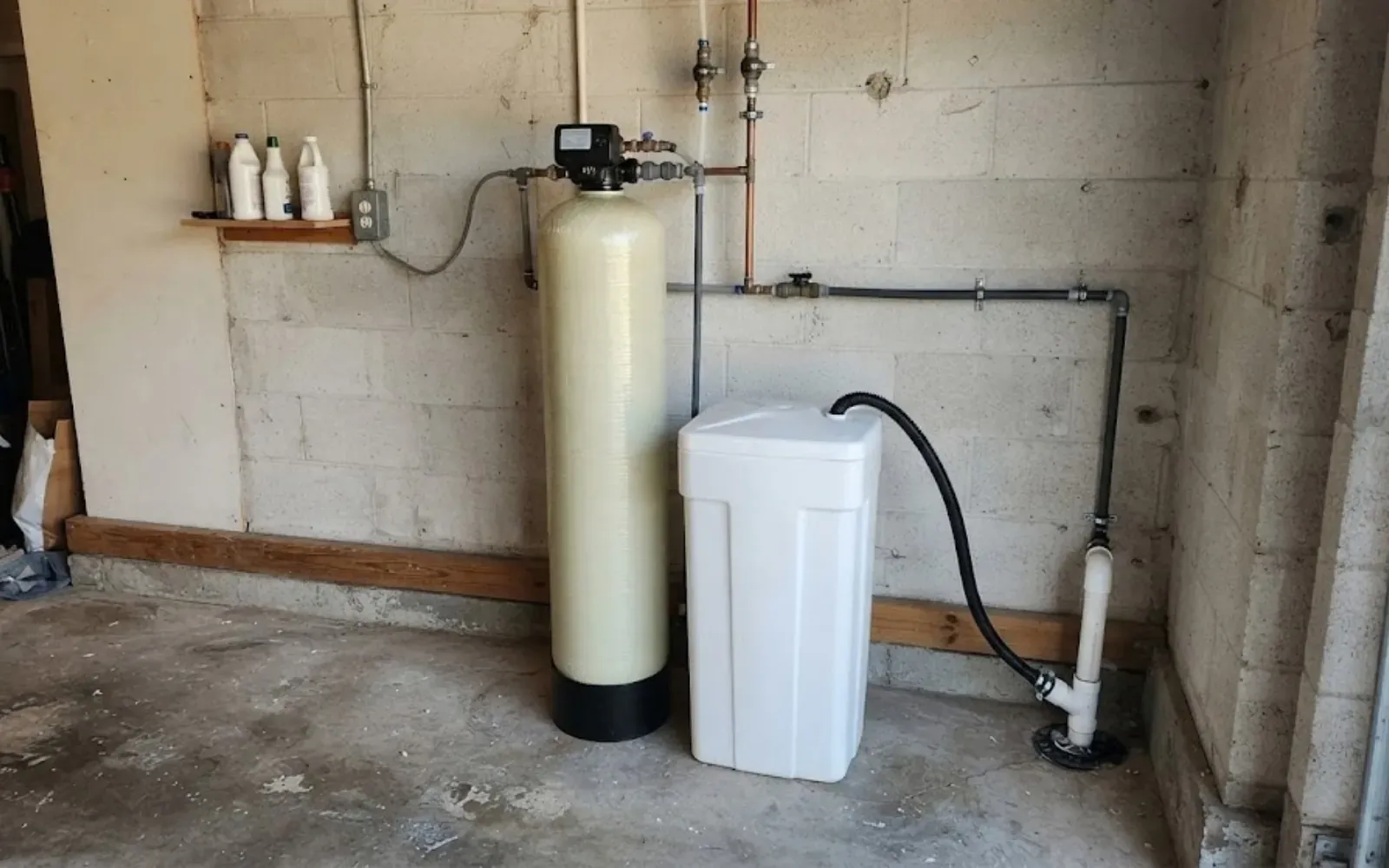
How a softener installation is laid out
A plumber follows a typical sequence.
- STEP 01
Choose the location
The unit goes after the main shutoff and before the water heater, with room for service.
- STEP 02
Plumb the loop
Supply, bypass and outlet are plumbed with shutoff valves and unions.
- STEP 03
Connect the drain
The regeneration drain runs to a legal point with an air gap.
- STEP 04
Power and program
The controller is powered and programmed for the water's hardness.
- STEP 05
Test and set
Water is run through, hardness is tested and the settings are confirmed.
Why indoor beats outdoor for most homes
Inside a garage or utility room, the unit is protected from freezing, sunlight and weather. The drain is easier to connect to a legal point, and the controller stays dry.
An outdoor install makes sense only when there is no interior room. If you must go outside, build a protective enclosure, insulate and heat the pipes and ask the manufacturer in writing whether the model supports outdoor use.
Huntersville note: soft water and the regeneration drain
Charlotte Water's posted monthly mineral analysis for treated water at its Franklin plant lists total hardness at 39 ppm, and its 2022 water quality report gives the average pH as 8.6. Soft water means a softener has little to remove, so compare your own test result before you spend money.
A softener's regeneration brine goes down a drain. Ask Charlotte Water at 311 or 704-336-7600 where discharge is allowed for your address, and check any HOA rules before an outdoor install. Mecklenburg County Code Enforcement at 980-314-2633 can tell you whether plumbing changes need a permit.
A softener's drain connection and bypass fall under the state plumbing code, the International Plumbing Code (IPC) with North Carolina amendments, and it covers how the drain is protected from backflow. Ask the plumber to show you how that protection is made on your install.
Salt, regeneration and household habits
A softener regenerates on a schedule, using salt and water to flush the resin. In soft water, an overly frequent schedule wastes both. If you install one, program it for the actual hardness and the household's use.
Some households want a softener for the feel of the water, not for scale. That is a reasonable preference, but it is a preference, and the cost of salt and maintenance goes with it.
Water treatment questions in Cornelius
Cornelius is served by the same utility, so the same questions apply. Our Cornelius page describes how we serve that town, and our service areas page lists the others.
Reading a hardness test result
Home test strips report hardness in grains per gallon or parts per million. One grain per gallon equals about 17 mg/L, so a strip that reads about two grains is close to the 39 ppm Charlotte Water posts. A reading far above that on your tap deserves a second test.
If a test gives a surprising number, repeat it, and ask a lab for a proper analysis. Equipment should follow the result, not the other way round.
Installing near a water heater or the main
If you do treat water, the softener belongs near the main, before the water heater, with a bypass. Plan for service access, because a softener needs salt refills and yearly checks. A corner that cannot be reached is a poor spot.
A plumber can run the supply, bypass and drain, and leave the unit ready for programming. Keep the manual and the settings in a folder.
Other treatment you might want instead
If your complaint is taste or smell from chlorine, a carbon filter does more than a softener. If you have staining, a test can show whether iron is the cause. If you have a well, test the well for hardness, iron and bacteria before you buy any equipment.
A plumber can install a filter, a regulator or a softener once you know what the water needs. See our plumbing installation page for planned work.
Huntersville questions: Install a water softener outside
Charlotte Water's posted monthly mineral analysis lists total hardness at 39 ppm, which the USGS places in its soft range. Your tap may differ, so test it.
Probably not for scale control if your water tests soft. A home test tells you for certain.
Only if the manufacturer rates it for outdoor use, and with protection from freezing and sun.
To a legal drain point with an air gap. Ask Charlotte Water at 311 about discharge rules for your address.
It may be needed for plumbing changes. Call Mecklenburg County Code Enforcement at 980-314-2633.
A carbon filter for chlorine taste, or other treatment depending on a test result.
Send your hardness test result and we will say what, if anything, to install. Call (704) 951-1635.